
Board games and neurodivergence
Games are one of the core social building blocks of early development. As well as improving skills like planning and inhibition control, they teach cooperation and joint attention and help us sharpen theory of mind skills such as strategising and bluffing.
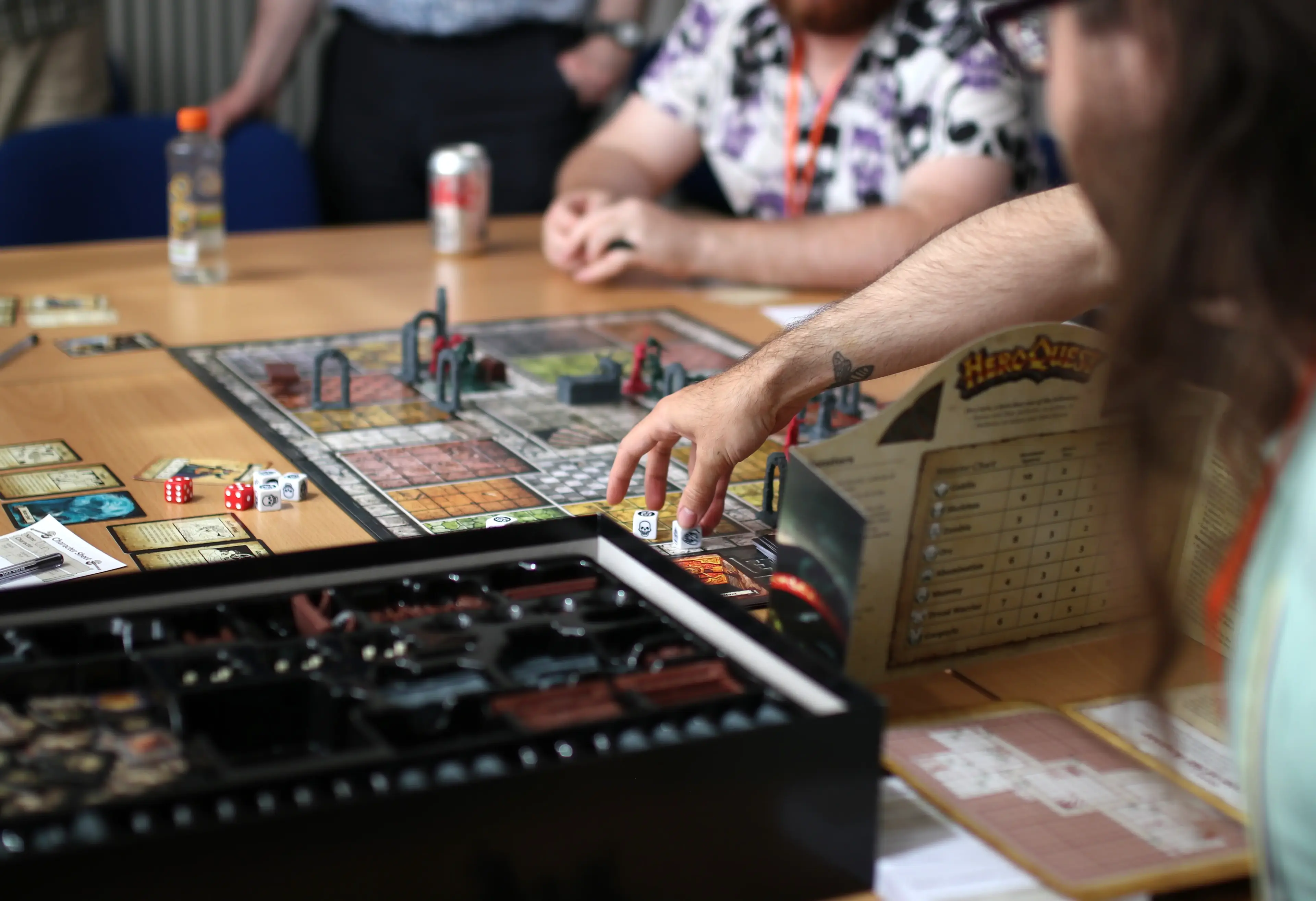
Our work focuses on how tabletop role-playing games and board games improve social skills, and how this can benefit autistic and otherwise neurodivergent people. We are also interested in exploring why it is that certain people are drawn to the hobby in the first place; and how environments can be designed to be more inclusive, accessible, and meaningful for diverse communities.
We study the board gaming community directly, including an open dataset of more than 1,500 board gamers, and have developed a qualitative research method that uses the game Dixit.
Talks
Papers on this topic
Liam Cross, Gray Atherton, Chris Stiff (2025)
A Path Out: Using Video Games to Reduce Prejudice Towards Refugees
Behavioral sciences
Abstract
Historically, research on video games has centred on their potentially adverse effects, though more recently, work has started to explore the benefits. here, we investigate whether playing a video game portraying a refugee’s plight in escaping war-torn syria could affect implicit and explicit attitudes towards that social group. we show that after 30 min of game play embodying a syrian refugee, participants showed reduced prejudicial attitudes and increased empathy towards syrian refugees compared to those playing a mechanically similar but contextually unrelated game. while implicit attitudes followed the same direction, this difference was not statistically significant. potential theoretical underpinnings of these findings, including perspective taking, embodiment, and contact perspectives for prejudice reduction, are discussed.
Gray Atherton, Emily Dawson, Liam Cross (2025)
Metaphors and myths: using the board game Dixit to understand the autistic lived experience
Discover psychology, 5(1), 1-17
Abstract
Autism is a condition that takes on many meanings, particularly to those with lived experience. exploring these meanings is paramount to being able to improve the way that autistic people are treated in the wider world. to further examine autistic lived experience, a new form of qualitative analysis was developed in line with the growing trend of gamification, or creating a game-like condition for exploring different domains. in this paper, we present dixit-elicitation, a form of qualitative inquiry that uses the popular board game dixit to interview autistic people about their experiences living with the condition. themes and subthemes relating to challenges, strengths, and societal expectations are discussed, along with the images found in the relevant dixit cards, which lead to a more nuanced understanding of the metaphors and myths experienced by autistic people. these themes are discussed, along with the …
Gray Atherton, Emily Dawson, Liam Cross (2024)
" We've All Come Together": A Board-Gaming Approach for Working with Autistic People.
American journal of play, 16(1), 97-122
Abstract
The authors discuss how board games offer individuals with autism (who often struggle with social settings and require structured outlets for building relationships) an affordable, naturalistic, collaborative environment that is stimulating, engaging, and educational. board games, they assert, provide opportunities to practice social skills, including cooperation and social deduction, essential skills for both neurotypical and atypical people. the authors include recommendations for introducing board games into special educational settings.
Gray Atherton, Rhys Hathaway, Ingela Visuri, Liam Cross (2024)
A critical hit: Dungeons and Dragons as a buff for autistic people
Autism
Abstract
Tabletop role-playing games (TTRPGs) are increasingly used in therapeutic and educational settings to improve the well-being of autistic people. This study investigated the potential of TTRPGs to provide a safe space where autistic adults could develop relationships with others while also engaging in character and world-building. Eight autistic adults were split into two groups and taken through a 6-week online Dungeons and Dragons campaign run by one of the researchers. Semi-structured interviews were then conducted to discuss how participants felt interacting in and out of the TTRPG. Several key themes were identified as important aspects of why autistic people could benefit from role-playing environments. The analysis showed that the participants felt a strong level of enjoyment from engaging in tabletop role-playing and, in many ways, experienced better social interactions during the TTRPG...
Liam Cross, Francesca Belshaw, Andrea Piovesan, Gray Atherton (2024)
Game changer: Exploring the role of board games in the lives of autistic people
Journal of autism and developmental disorders, 1-20
Abstract
This mixed methods paper reports findings from three studies examining the overlap between autism and hobbyist board gaming. the first was a quantitative survey of over 1600 board gamers, showing that autistic individuals are overrepresented in this hobby compared to the general population and that autistic traits measured by the aq are significantly elevated amongst board gamers. study 1 also assessed gamers’ motivations and preferences and reported key differences as well as similarities between autistic and non-autistic gamers. the second was a qualitative study that reported the results of 13 interviews with autistic individuals who are hobbyist board gamers. using interpretive phenomenological analysis (ipa), four key themes were uncovered, including a preference for systemising, escapism and passions, the social lubrication effect of games and difficulties with deception. in the third, 28 autistic …